Travel Meets Programmatic: Capturing Demand Across the Whole Funnel
Discover how travel brands can use programmatic advertising and real-time data to navigate the non-linear purchasing journey and capture consumer demand from inspiration to booking.


Travel Meets Programmatic: Capturing Demand Across the Whole Funnel
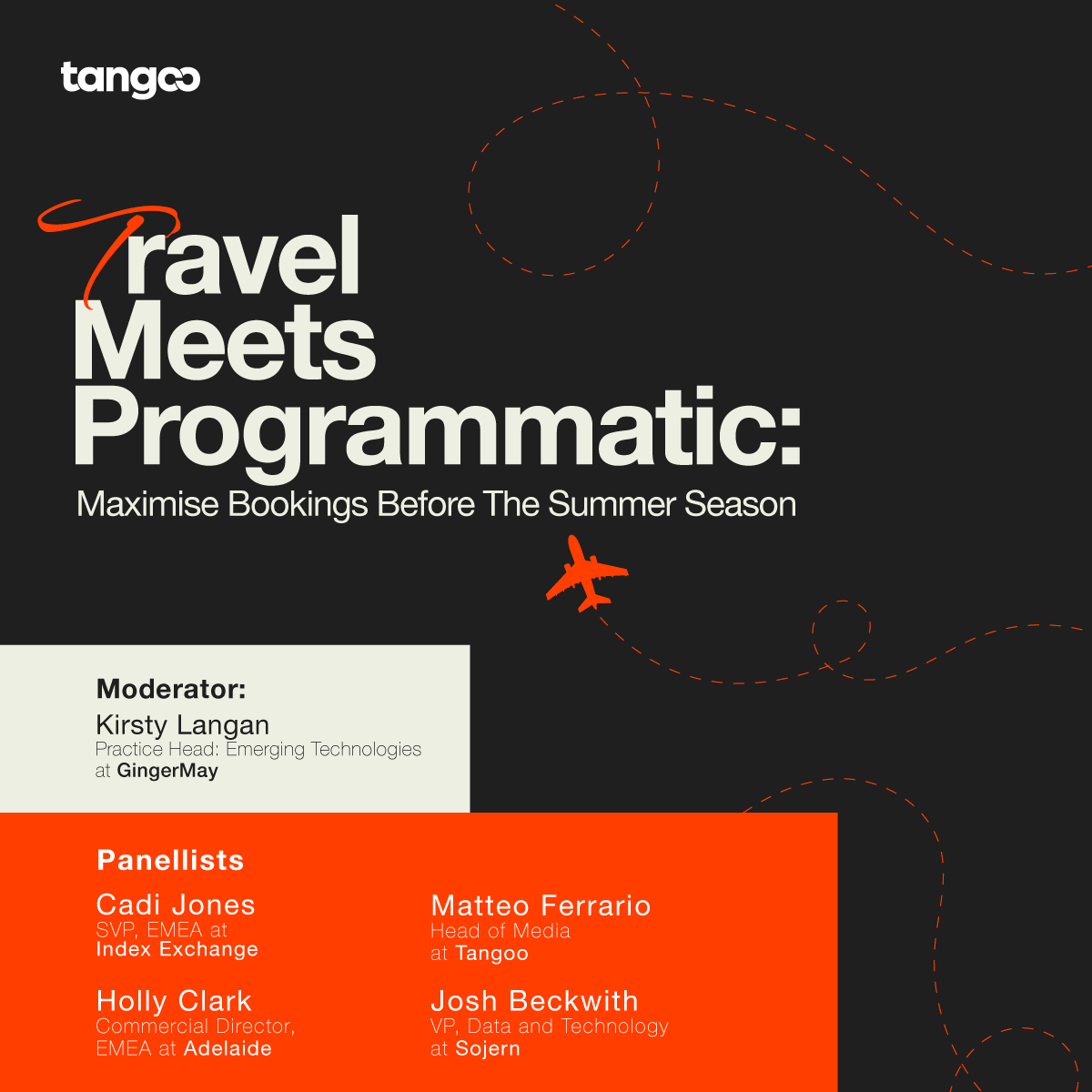
Travel buying is rarely a straight line. People drift from inspiration to intent over weeks or months, switch destinations halfway through, book a hotel before a flight, and change their minds when fuel prices or headlines shift. At our recent London panel, hosted ahead of the busy summer season, experts from Tangoo, Index Exchange, Sojern, and Adelaide sat down to unpack how travel brands can use programmatic to reach travelers at the right moment, optimize their media investment, and drive bookings across awareness, consideration, and conversion.
Awareness: Brand Plus Tactical, Not Brand Versus Tactical
The panel opened on a familiar Q2 tension: when competition peaks, should brands chase broad visibility or qualified audiences? The consensus was that there is no single right answer, and that framing it as a choice misses the point.
Cadi Jones (Index Exchange) argued the decision depends entirely on each brand's circumstances, and that programmatic is what makes either path workable. The discipline that unifies both ends of the funnel is the same: deciding which audiences to reach, in which environments, and how to deliver the ad reliably to them.
Josh Beckwith (Sojern) pushed the audience side hard. A master brand matters, but travelers need different messages at different moments based on actual behavior. Marriott can speak to a midweek business stay for a solo traveler or a week-long beach resort for a family of four, and the same person needs both messages at different times. His verdict on the brand-versus-tactical debate was simple: brand plus tactical.
Holly Clark (Adelaide) reframed reach around quality. Reach matters and always will, but the real question is the quality of that reach and whether every impression is given the chance to deliver attention. She noted brands honing in on quality impressions rather than chasing every available one have improved KPIs by up to 80% and beyond.
Matteo Ferrario (Tangoo) tied it together: massive reach without precision is just noise. Programmatic lets teams read the bid stream and judge whether reach is genuinely qualitative, then combine that with third-party signals before and during activation. The technical advances making this possible, like targeting and quality assessment at the individual placement level rather than judging a publisher as simply good or bad, mean more is possible now than ever before.
Inspiration Has to Precede Intent
Travel is emotive. It taps into identity, memory, and aspiration, and it often begins with inspiration long before anyone searches for a destination. The panel turned to how brands engage people who have not started looking yet.
Josh made the case that inspiration is largely the job of the destination marketer, and that if you are only branding for summer once summer arrives, you are already too late. The patterns are readable: content engagement, video consumption, and social behavior all signal interest before someone reaches a metasearch site. The work is in interrogating your CRM, reading those signals, and enriching your data to find people who look like the travelers you already know.
He also stressed how variable the timing is. Search-to-book and book-to-travel windows differ by destination, origin market, and budget. A family booking a $10,000 trip might commit six months out, while a couple chasing a cheap city break might book for this weekend. Broad statistics will mislead you; the data has to be interrogated case by case.
Cadi pointed to CTV as the format that changed the inspiration game across Europe. Destinations and tourist boards historically struggled to find the right environments. CTV gives them the big-screen storytelling experience while holding the media to the same accountability on targeting, measurement, and optimization as performance channels. Travel brands are leaning into it precisely because the media is now accountable.
Matteo added that CTV and digital out of home are no longer awareness-only channels. Someone can watch an ad in their living room and open their phone to book in the same session, or get retargeted in the days that follow. He also made the case for treating creative formats as assets that adapt across channels, from CTV to mobile to audio, shaped not just by technical specs but by the micro-moment the user is living in. Audio is a one-to-one conversation that should fit the moment, whether that is a morning podcast or a commute playlist.
Consideration: Frequency, Quality, and Suppression
Travel is heavily researched over a long cycle, so staying relevant without becoming an annoyance is its own discipline.
Holly framed consideration as finding the balance between reach, frequency, and quality, with the sweet spot looking completely different depending on whether someone is a last-minute booker or considering months ahead. The job is identifying the optimal point where outcomes are achieved, spotting where performance starts to drop off, and adjusting media buying accordingly.
Josh highlighted a data advantage unique to travel: the industry is underpinned by global distribution systems and rates-and-availability feeds. Marrying that supply data with demand data lets brands deliver meaningful price and availability for a specific route at the moment consideration ramps up.
Matteo brought the conversation to creative. Tangoo uses attention data to optimize creative rotation and build ad sequencing strategies, testing whether different creative assets perform against the same placement, publisher, and audience. The shift, he argued, is away from vanity and legacy metrics toward reading the micro-signals and micro-moments that actually drive planning and execution.
Cadi raised the question hanging over all of it: travel generates more data than any human can hold in their head, and AI is increasingly doing that work. The move toward curation and sell-side decisioning, layering publisher and supply-side signals while the DSP still controls price and delivery, is driving exceptional results precisely because of the volume of data involved.
Using First-Party Data Without Annoying People
The panel was candid about the difference between using data well and just following people around the internet.
Josh made the point that data is far more valuable than repeating the same message. Enriching a CRM, matching it against other datasets, and finding out more about people who are not currently in market opens up thoughtful engagement rather than repetition. He singled out suppression as underdiscussed: if someone has booked the hotel but not the flight, stop showing them the hotel. Show them breakfast options, activities, a partner offering a city tour. Use the data to personalize, and travelers will hand over more of it.
The group agreed travelers are unusually willing to share data in exchange for value, comparable to grocery loyalty schemes. With programs like Marriott's running into hundreds of millions of members, the expectation is clear: if I give you my data, enhance my experience in a way that is meaningful to me rather than serving the same ad on repeat.
Conversion: Curation and Sell-Side Decisioning
In the final stretch, the panel turned to whether data can help travel brands outsmart competitors when competition intensifies.
Matteo emphasized curation and supply-side strategy. Rather than simply loading a budget into a DSP and setting a flight live, deep-diving into auction logs, impressions, and bids gives more control and transparency over where every dollar of media spend goes, with the ability to optimize in near real time and reallocate saved budget to better placements.
Cadi gave the clearest explanation of why curation matters. Header bidding left DSPs unable to ingest 100% of available supply, so for years buyers were best-guessing what to feed each platform. Sell-side decisioning lets the buyer pick and choose inventory and audiences across the full scale of the SSP rather than the slice that reaches the DSP. For brands chasing niche travel audiences, or scale in quality environments, that can mean five to ten times the reach they could previously access, and at better cost efficiency.
Holly returned to the quality argument: brands invest heavily in loyalty programs, CRM, and creative, and media quality is about giving every placement the best chance for that data and creative to deliver the outcome. Deliver the highest quality on every available placement first, let the richness of the data and the creative work, then optimize around it.
Josh closed the section on measurement. He described himself as a believer in insight in and measurement out, knowing why you are delivering a message and measuring rigorously on the way back. With creative, contextual, placement, and audience measurement feeding back into the algorithm, AI then makes a million decisions a minute that no human trader could match.
Planning the Next Few Months
Asked how they would advise a travel brand on the coming summer, the panel was unanimous on one point and varied on the rest.
Josh's headline takeaway: do not use last year's data to plan this year. The environment has shifted too much, from price sensitivity to certain regions becoming less attractive. Ask for live insight on today's load factors and search volumes, interrogate your first-party data, and watch the emerging space of synthetic data, which lets brands test and learn against a modeled audience cheaply and quickly.
Cadi advised getting back to basics: identify the audiences that will move the needle this summer, then work out how to find them at scale in the right environments. She flagged sell-side decisioning and custom algorithms built on the fly as the innovation she is most excited about, with results strong enough that one case study was set aside as implausibly good.
Matteo reminded everyone that consumers have not disappeared, they have just become more uneven, so the strategy and mindset have to adapt to where they actually are. On innovation, he pointed to creative metadata: tagging creative assets by their elements, comparing performance data like attention and viewability, and using those insights to inform the next strategy and replicate what works across similar brands, with AI helping read and organize it all at speed.
Holly's closing thought captured the mood of the room. In the next few months, the travel brands that win will not necessarily be the ones with the biggest budgets, but the ones smartest with the budgets they have. With budgets more constrained, every pound has to work harder, which makes curation, real-time optimization, and moving away from legacy metrics more valuable than ever.
A big thank you to our panel:
Moderated by Kirsty Langan, GingerMay
Matteo Ferrario, Head of Media at Tangoo
Cadi Jones, SVP EMEA at Index Exchange
Holly Clark, Commercial Director EMEA at Adelaide
Josh Beckwith, VP Data & Technology at Sojern